Unit 3 Sections 14 and 15
Libraries and Random Values




- wget https://raw.githubusercontent.com/aidenhuynh/CS_Swag/master/_notebooks/2022-11-30-randomvalues.ipynb
- Libraries
wget https://raw.githubusercontent.com/aidenhuynh/CS_Swag/master/_notebooks/2022-11-30-randomvalues.ipynb
Libraries
- A library is a collection of precompiled codes that can be used later on in a program for some specific well-defined operations.
- These precompiled codes can be referred to as modules. Each module contains bundles of code that can be used repeatedly in different programs.
- A library may also contain documentation, configuration data, message templates, classes, and values, etc.
Why are libraries important?
- Using Libraries makes Python Programming simpler and convenient for the programmer.
- One example would be through looping and iteration, as we don’t need to write the same code again and again for different programs.
- Python libraries play a very vital role in fields of Machine Learning, Data Science, Data Visualization, etc.
A few libraries that simplify coding processes:
- Pillow allows you to work with images.
- Tensor Flow helps with data automation and monitors performance.
- Matplotlib allows you to make 2D graphs and plots.
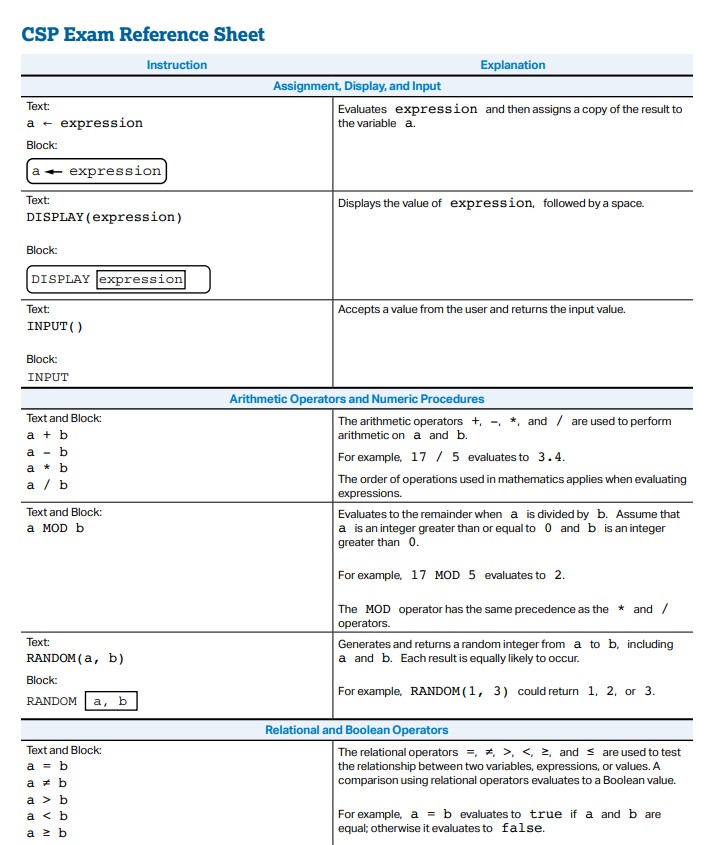
The AP Exam Refrence Sheet itself is a library!
Hacks:
Research two other Python Libraries NOT DISCUSSED DURING LESSON and make a markdown post, explaining their function and how it helps programmers code.
API’s
- An Application Program Interface, or API, contains specific direction for how the procedures in a library behave and can be used.
- An API acts as a gateway for the imported procedures from a library to interact with the rest of your code.
Activity: Walkthrough with NumPy
- Install NumPy on VSCode:
- Open New Terminal In VSCode:
- pip3 install --upgrade pip
- pip install numpy
REMEMBER: When running library code cells use Python Interpreter Conda (Version 3.9.12)
Example of using NumPy for arrays:
import numpy as np
new_matrix = np.array([[1, 2, 3],[4, 5, 6],[7, 8, 9]])

print (new_matrix)
import numpy as np

# defining polynomial function
var = np.poly1d([2, 0, 1])
print("Polynomial function, f(x):\n", var)

# calculating the derivative
derivative = var.deriv()
print("Derivative, f(x)'=", derivative)

# calculates the derivative of after
# given value of x
print("When x=5  f(x)'=", derivative(5))
Random Values
- Random number generation (RNG) produces a random number (crazy right?)
- This means that a procedure with RNG can return different values even if the parameters (inputs) do not change
- CollegeBoard uses
RANDOM(A, B), to return an integer between integersAandB.- RANDOM(1, 10) can output 1, 2, 3, 4, 5, 6, 7, 8, 9, or 10
- In Python, this would be
random.randint(A, B), after importing Python's "random" library (import random) - JavaScript's works a little differently, with
Math.random()returning a value between 0 and 1.- To match Python and CollegeBoard, you could make a procedure like this
CollegeBoard Example: What is the possible range of values for answ3

import random # Fill in the blank

def Dice(n):
    sum = 0
    while(n!=0):
        sum = sum + random.randint(1,6)
        n = n-1
    return(sum)

Dice(5) # Will output a range of __ to __
Homework
-
Write a procedure that generates n random numbers, then sorts those numbers into lists of even and odd numbers (JS or Python, Python will be easier).
-
Using NumPy and only coding in python cell, find the answer to the following questions: a. What is the derivative of 2x^5 - 6x^2 + 24x? b. What is the derivative of (13x^4 + 4x^2) / 2 when x = 9?
-
Suppose you have a group of 10 dogs and 10 cats, and you want to create a random order for them. Show how random number generation could be used to create this random order.
import random

n = int(input("How many numbers do you want generated?"))  # number of random numbers to generate
random_numbers = []
even_numbers = []
odd_numbers = []

# generate n random numbers
for i in range(n):
  random_number = random.randint(1, 100)
  random_numbers.append(random_number)

# sort numbers into even and odd lists
for number in random_numbers:
  if number % 2 == 0:
    even_numbers.append(number)
  else:
    odd_numbers.append(number)

print("You wanted", n, "numbers to be generated.")
print("Even Numbers:", even_numbers)
print("Odd Numbers:", odd_numbers)
import numpy as np

# Define the polynomial
poly = np.array([13, 0, 4, 0, 0])

# Calculate the derivative
derivative = np.polyder(poly)

# Define result
result = np.polyval(derivative, 9)

# Print
print(result)
import numpy as np

# Define the polynomial
poly = np.poly1d([2, 0, -6, 24, 0])

# Calculate the derivative
derivative = np.polyder(poly)

# Print the derivative
print(derivative)
import random

cats = ["cat" + str(i) for i in range(10)] # makes cat1, cat2... in list by adding the num from range to a index
dogs = ["dog" + str(i) for i in range(10)] # makes dog1, dog2... in list by adding the num from range to a index

pets = cats + dogs # adds the lists together

random.shuffle(pets) # shuffles the pets list

print(pets)